The house project and the home lab meet in my Home Assistant floor plan. Blender provides the visual model. Home Assistant provides the state. A custom Lovelace card brings the two together.
The browser does not render a live 3D house. It combines pre-rendered images. That distinction keeps the visual experiment small enough to understand and gives each part of the system a clear job.
#A rendering is a view, not the source of truth
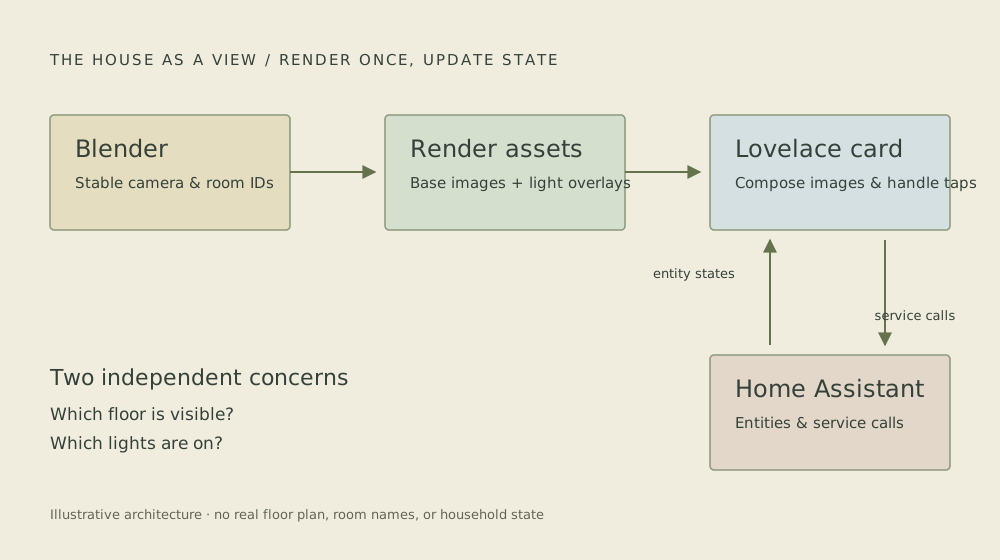
Open the diagram at full size.
Blender exports day and night base images plus overlays for room lighting. The card reads Home Assistant entity states and chooses which overlays to draw. When someone interacts with a mapped room, it sends a normal Home Assistant service call.
The visual assets and the automation state can therefore change independently. A lamp replacement should normally mean an entity-mapping change, rather than rebuilding the model of the house.
#Map the room deliberately
This is the shape of a room override for my custom card. The room and entity names below are invented; they do not describe the actual household layout.
# rooms.yaml — for custom:kroit-floorplan-card
EG/Studio:
  name: Studio
  lights:
    - light.studio_ceiling
    - light.studio_desk
  temperature: sensor.studio_temperature
  presence: binary_sensor.studio_presence
The key has to match the room identifier in the render assets. Explicit mappings also make a useful boundary: a switch should not become a room light merely because it appears in the same area. Some devices expose configuration or screen controls as switches.
This YAML is specific to my custom card, not a built-in Home Assistant feature.
#The hidden floor still needs a test
The selected floor and the state of its lights are separate concerns. A room can change state while its floor is hidden, and an update should not make that hidden floor visible.
That turned into a concrete regression case in the project. It is a good reminder that a convincing rendering is only part of the interface. The state transitions need to make sense too.
The fuller engineering write-up covers the additive light composition, alpha masking, explicit mappings, and the regression test. I keep that reusable technical material on Cloudsium: a Home Assistant floor plan rendered in Blender.
Here, I want to keep the wider thread: using software to make the house easier to understand, while keeping the visual layer free to evolve.